



The Retirement Plan Sandbox: 2026 Retirement Plan Comparison
Did you know that you can still have a 401(k) when you are self-employed? An Individual 401(k) or an enhanced SIMPLE IRA could typically be a good retirement vehicle for Direct Care physicians.
Physicians and dentists looking to maximize tax shelters should get to know retirement plan options – especially when or before hiring staff.
Direct Care models (DPC/DDC) eliminate insurance friction, resulting in predictable cash flow and potentially better profit margins. By selecting the right retirement chassis you can protect more of your earnings from the high tax brackets while providing competitive benefits to any potential key team members that you now have or plan to hire.
The Retirement Plan Sandbox: 2026 Retirement Plan Comparison
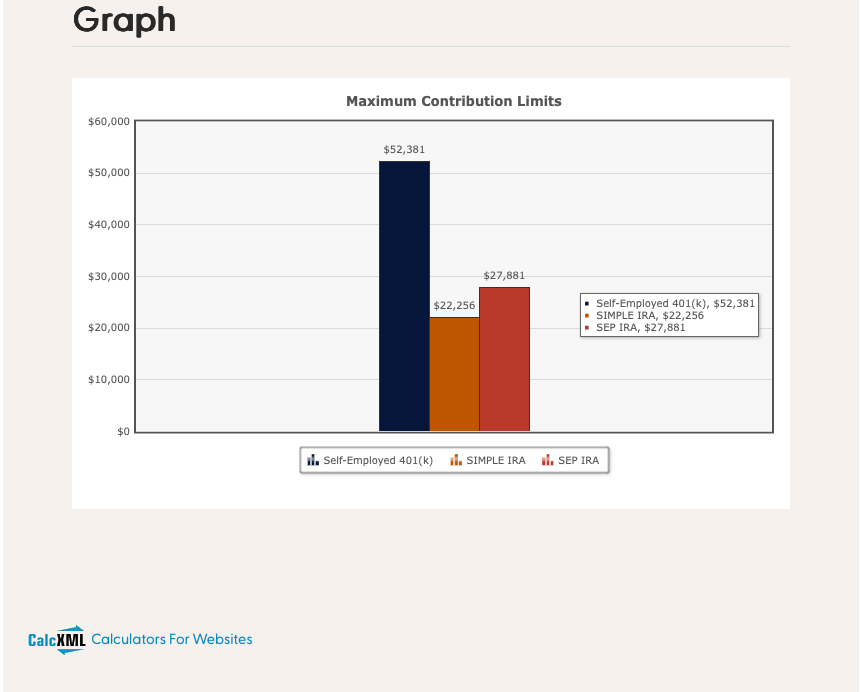
The example in the graph is computed by CalcXML. It shows maximum contributions that you could make using each plan type. I assumed a profit for that year of $150,000.
For a thriving Direct Care practice, retirement options generally fall into three options. Below is a side-by-side comparison of the rules, contribution limits, and structural frictions based on the 2026 numbers. This is not an exhaustive list of options for my clients.
Calculate my contributions for me
| Plan Feature | SIMPLE IRA | SEP IRA | Solo 401(k) |
|---|---|---|---|
| Best Suited For | Small practice running payroll with up to 25 employees. | Solo practitioners or husband-wife practices with no employees. | High-earning owners looking to maximize tax deferrals up to – but not necessarily – the absolute cap. |
| Employee Deferral | $17,000 (Up to $18,100 for teams under 25). | $0 (Employees cannot make personal salary deferrals). | $24,500. |
| Catch-Up Amounts (Age 50+) | $4,000 standard; $5,250 super catch-up (Ages 60–63). | N/A. | $8,000 standard for 50+; $11,250 super catch-up (Ages 60–63). |
| Employer Requirements | Mandatory 100% immediate vesting; 3% match or 2% non-elective contribution. | Must contribute an equal percentage to all eligible employees. | Flexible matching setups; subject to annual non-discrimination testing unless Safe Harbor is used. |
| Total Contribution Caps | Limit varies by compensation, age and match structure. | Generally, 25% of a practices profit. But not more than $72,000. | Up to $72,000 (or up to $80,000+including catch-up). |
Strategic Takeaway for Practice Owners
- The SEP IRA “Trap”: While a SEP IRA allows a massive $72,000 ceiling, the rules stipulate that you must give your staff the exact same percentage contribution you give yourself. If you put 25% of your total wage away toward the plan, then your employees must get 25% of their wage. This is a very generous benefit if you are prepared to offer it to all eligible employees.
- The Solo 401(k): A smaller-scale 401(k) option does exist. It allows you to aggressively defer the maximum annual limit out of your own paycheck before factoring in corporate profit-sharing. The profit-sharing comes from additional money earned through your practice. Some Solo 401(k) plan agreements do stipulate that non-related employees can participate. But understand your plan agreement prior to hiring and offering your Solo 401(k) benefit.
- The Lean and SIMPLE approach: If you operate a small office with a small number of employees, then enhancements made under the Tax Cuts Jobs Act can provide a higher individual deferral of $18,100 with limited annual administrative hurdles and no form 5500 filing requirements.
Disclosures
This information may help you analyze your financial needs. It is based on information and assumptions provided by you regarding your goals, expectations and financial situation. The calculations provided should not be construed as ERISA, financial, legal or tax advice. In addition, such information should not be relied upon as the only source of information. This is for illustrative purposes only. Your results may vary.
This material was created for educational and informational purposes only and is not intended as ERISA, tax, legal or investment advice. If you are seeking investment advice specific to your needs, such advice services must be obtained on your own separate from this educational material.
- Mullin's take on the "4% Retirement Rule"
- Navigate "Bad Portfolio Weather"
- Tips to Optimize Social Security







Articles and Assets
What are your Priorities?
Well it’s the end of the year. I just searched on Google for “market outlook 2018.” I came up with a little over 58-million “results.”
So should you be investing in stocks in 2018? The quick answer: It’s likely a prudent part of your portfolio. But it depends on your circumstances, right?
It’s apparently popular to throw your hat in the ring.
A mantra that you hear among disciplined professionals is to “stay the course.”
Then you hear “sell high, buy low.”
Who’s right?
The relief of a disciplined strategy is that it can be tailored to you. And tailor we think you should.
Yes, it’s possible that an investor may not utilize stocks in their portfolio at all. Or you may decide to go “all in” with a diversified stock portfolio.
(Side effects from tailoring a strategy may include increased confidence & persistence, apathy toward daily market reports, and increased focus on what really matters.)
Let’s begin with the “Why” of investing for you. Then you can request 15-minutes on the phone discuss your “how.”
So “Why Should You Invest”
Life changes and our “why” of investing ought to transform with life. Some invest for sport – they like the risk/reward of investing – they’re in it for the thrill. I don’t hang with this crowd.
Most of us ought to invest for things we want. Our money & our goals are serious. By investing in a diversified portfolio we can pursue things we want.
1. Living A Comfortable Retirement: Retirement is a noun. It’s up to you to really design and live a retirement that reflects you.
2. Purchasing a Home: Home is a place to live. It can take a down payment.
3. Passing an Inheritance on to Family:
4. Student Loan Shield: This idea is important for many Millennial graduates. Student loans can dominate your budget. But instead of accelerating those payments, what if you paid your required payments, and then invested the additional money that you were going to pay against your loan balance?
5. Emergency Reserves: You probably have read that it’s prudent to keep a relative healthy amount of cash in your checking/savings. Once you’ve achieved that, then you can consider investing additional funds. Go a step further and consider a non-retirement account for you and your house. You can spend this on cars, vacations or use it just as described in #4.
The Dow Jones has seen positive results, so far, in 2017. It’s unusual and sort of uncomfortable as the independent financial advisor. Why is it uncomfortable?
What would sting & linger longer? Finding $20 in the parking lot? Or finding a $20 parking fine on your windshield?
We’ve been finding a lot of metaphorical “$20’s” (i.e. “positive results”) in our portfolios this year. So the second we find a parking fine (or a few in a row) we’ll be sure to ask if stocks are still the right place to park our money.
Complacency can work against us, Dear Clients. Just keep recalling your long-haul strategy and your “why” of investing.
***
Peter Mullin is an independent financial advisor registered through LPL Financial. He lives in Rogers, MN with his family. He was born and raised in St. Cloud, MN. Mullin Wealth Management is located in Waite Park, MN.
The opinions voiced in this material are for general information only and are not intended to provide specific advice or recommendations for any individual.
Investing involves risk including loss of principal.
There is no guarantee that a diversified portfolio will enhance overall returns or outperform a non-diversified portfolio. Diversification does not protect against market risk.
All performance referenced is historical and is no guarantee of future results.
All indices are unmanaged and may not be invested into directly. No strategy assures success or protects against loss.