




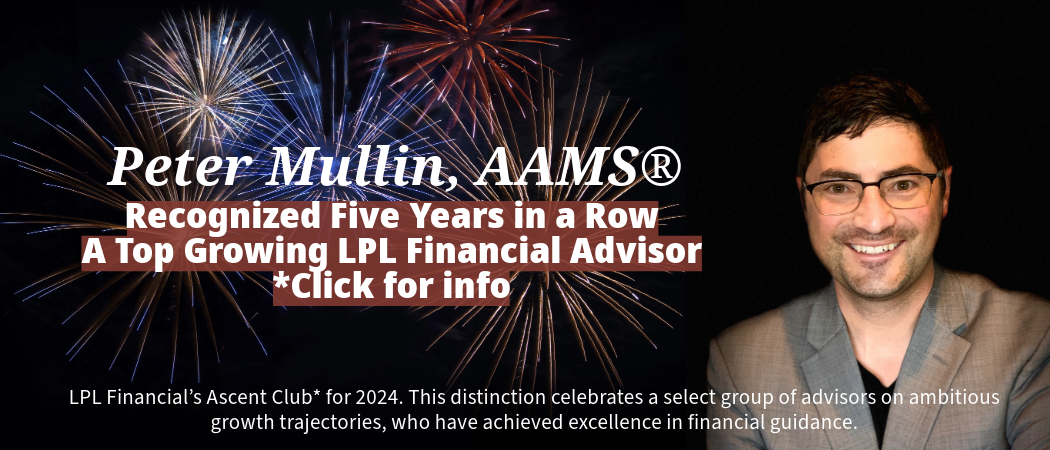
PETER MULLIN RECOGNIZED AS ONE OF LPL FINANCIAL’S TOP FINANCIAL ADVISORS
FOR IMMEDIATE RELEASE
PETER MULLIN OF MULLIN WEALTH MANAGEMENT RECOGNIZED AS ONE OF LPL FINANCIAL’S TOP FINANCIAL ADVISORS
MINNESOTA — MAY 1, 2024 – Peter Mullin, a financial advisor at Mullin Wealth Management in Central Minnesota, today announced that his achievements have been recognized with inclusion in LPL Financial’s Ascent Club* for 2024. This distinction celebrates a select group of advisors on ambitious growth trajectories, who have achieved excellence in financial guidance. As America’s investing public looks ahead to continued macroeconomic uncertainty and market volatility, it is critical they have an experienced financial partner by their side to help them manage, preserve, and deploy their wealth.
Mullin serves clients based in the Midwest, providing comprehensive wealth management services, including: investment management, retirement planning, tax planning, charitable giving and estate planning.
“Recognition like this to me shows the power of relationships compounding in this business. It is awesome to see grassroots growth through so many passing my name on to friends and family. Thank you clients! You have my gratitude.”
“On behalf of the entire team at LPL, I am thrilled to congratulate Peter Mullin on his outstanding achievements in 2023,” said Julian Lopez, LPL’s Executive Vice President of Independent Advisor Services Relationship Management. “By utilizing our proprietary technology and suite of customized services, Peter has taken his business to the next level, allowing him to dedicate more time to building meaningful client relationships with families in the Midwest. Through his guidance, he has been instrumental in helping these families turn their aspirations into financial realities.”
Mullin has been affiliated with LPL Financial, a leading wealth management firm, for 13 years. Through LPL, financial advisors are empowered to focus on their unique skills in building client relationships and delivering personalized financial advice, while leaning on LPL to provide the services, support and tools to help increase operational efficiency and power business growth.
###
About LPL Financial
LPL Financial Holdings Inc. (Nasdaq: LPLA) was founded on the principle that LPL should work for advisors and enterprises, and not the other way around. Today, LPL is a leader in the markets we serve, serving more than 22,000 financial advisors, including advisors at approximately 1,100 enterprises and at approximately 570 registered investment advisor (RIA) firms nationwide. We are steadfast in our commitment to the advisor-mediated model and the belief that Americans deserve access to personalized guidance from a financial professional.
At LPL, independence means that advisors and enterprise leaders have the freedom they deserve to choose the business model, services, and technology resources that allow them to run a thriving business. They have the flexibility to do business their way. And they have the freedom to manage their client relationships because they know their clients best. Simply put, we take care of our advisors and enterprises, so they can take care of their clients.
Securities and Advisory services offered through LPL Financial LLC (“LPL Financial”), a registered investment advisor. Member FINRA/SIPC. LPL Financial and its affiliated companies provide financial services only from the United States.
Throughout this communication, the terms “financial advisors” and “advisors” are used to refer to registered representatives and/or investment advisor representatives affiliated with LPL Financial.
We routinely disclose information that may be important to shareholders in the “Investor Relations” or “Press Releases” section of our website.
*Achievement is based on annual production among LPL-affiliated investment programs only.
Securities and Advisory services offered through LPL Financial, A Registered Investment Advisor, Member FINRA/SIPC.
- Mullin's take on the "4% Retirement Rule"
- Navigate "Bad Portfolio Weather"
- Tips to Optimize Social Security







Articles and Assets
What are your Priorities?
Well it’s the end of the year. I just searched on Google for “market outlook 2018.” I came up with a little over 58-million “results.”
So should you be investing in stocks in 2018? The quick answer: It’s likely a prudent part of your portfolio. But it depends on your circumstances, right?
It’s apparently popular to throw your hat in the ring.
A mantra that you hear among disciplined professionals is to “stay the course.”
Then you hear “sell high, buy low.”
Who’s right?
The relief of a disciplined strategy is that it can be tailored to you. And tailor we think you should.
Yes, it’s possible that an investor may not utilize stocks in their portfolio at all. Or you may decide to go “all in” with a diversified stock portfolio.
(Side effects from tailoring a strategy may include increased confidence & persistence, apathy toward daily market reports, and increased focus on what really matters.)
Let’s begin with the “Why” of investing for you. Then you can request 15-minutes on the phone discuss your “how.”
So “Why Should You Invest”
Life changes and our “why” of investing ought to transform with life. Some invest for sport – they like the risk/reward of investing – they’re in it for the thrill. I don’t hang with this crowd.
Most of us ought to invest for things we want. Our money & our goals are serious. By investing in a diversified portfolio we can pursue things we want.
1. Living A Comfortable Retirement: Retirement is a noun. It’s up to you to really design and live a retirement that reflects you.
2. Purchasing a Home: Home is a place to live. It can take a down payment.
3. Passing an Inheritance on to Family:
4. Student Loan Shield: This idea is important for many Millennial graduates. Student loans can dominate your budget. But instead of accelerating those payments, what if you paid your required payments, and then invested the additional money that you were going to pay against your loan balance?
5. Emergency Reserves: You probably have read that it’s prudent to keep a relative healthy amount of cash in your checking/savings. Once you’ve achieved that, then you can consider investing additional funds. Go a step further and consider a non-retirement account for you and your house. You can spend this on cars, vacations or use it just as described in #4.
The Dow Jones has seen positive results, so far, in 2017. It’s unusual and sort of uncomfortable as the independent financial advisor. Why is it uncomfortable?
What would sting & linger longer? Finding $20 in the parking lot? Or finding a $20 parking fine on your windshield?
We’ve been finding a lot of metaphorical “$20’s” (i.e. “positive results”) in our portfolios this year. So the second we find a parking fine (or a few in a row) we’ll be sure to ask if stocks are still the right place to park our money.
Complacency can work against us, Dear Clients. Just keep recalling your long-haul strategy and your “why” of investing.
***
Peter Mullin is an independent financial advisor registered through LPL Financial. He lives in Rogers, MN with his family. He was born and raised in St. Cloud, MN. Mullin Wealth Management is located in Waite Park, MN.
The opinions voiced in this material are for general information only and are not intended to provide specific advice or recommendations for any individual.
Investing involves risk including loss of principal.
There is no guarantee that a diversified portfolio will enhance overall returns or outperform a non-diversified portfolio. Diversification does not protect against market risk.
All performance referenced is historical and is no guarantee of future results.
All indices are unmanaged and may not be invested into directly. No strategy assures success or protects against loss.