




Assessing the Impact of Developments in Iran: Watch Energy
Kristian Kerr | Head of Macro Strategy
Last Updated: March 02, 2026
Over the weekend, the United States and Israel conducted a coordinated series of missile and drone strikes against Iran, targeting several high-value military installations in an effort to hinder Iran’s nuclear development efforts. These operations resulted in the death of Iran’s Supreme Leader, Ayatollah Ali Khamenei, marking a significant escalation and immediately heightening regional tensions. Iran quickly retaliated by launching a broad series of missile attacks directed not only at Israel but also at multiple Gulf states, including Qatar, the United Arab Emirates, and Bahrain. The repercussions were felt across the region. Several Gulf countries responded by shutting down their airspace and closing their equity markets. The conflict also affected global energy flows. Tanker traffic through the Strait of Hormuz, a vital waterway that carries about 20% of the world’s oil supply, came to a near standstill as shipping companies diverted vessels away from the area for safety reasons. Plus, Qatar shuttered liquefied natural gas production at the world’s largest export facility after being targeted by an Iranian drone strike. President Donald Trump stated that U.S. strikes on Iran would continue, signaling that tensions are likely to remain elevated for the next few weeks.
From a market perspective, the energy market is the primary way through which this crisis is likely to impact global markets. Any sustained disruption to oil or natural gas flows, especially if both severe and long lasting, have the potential to influence inflation expectations, weigh on business confidence, and elevate volatility across asset classes. In simple terms, the more intense and prolonged the geopolitical shock, the larger the likely market impact.
This pattern was already evident when markets opened on Monday. Brent crude, the global benchmark for oil prices, briefly touched $82 per barrel as traders responded to the possibility of tighter supply conditions. A sustained period of elevated prices would place upward pressure on inflation expectations, and that in turn could have broader consequences for both equity and interest rate markets. However, for such a persistent rise in crude prices to materialize, markets would likely need evidence of a more prolonged or even total shutdown of the Strait of Hormuz. A disruption of that scale would represent a meaningful escalation relative to what has occurred so far and would justify a more substantial risk premium in energy markets. There is also a political dimension tied to Iran’s internal stability, particularly regarding how the Islamic Revolutionary Guard Corps (IRGC) chooses to respond. Whether it opts to pull back or escalate further will play a major role in determining how much of the current shock reflects elevated risk premiums versus a true disruption to physical supply.
Oil Prices Spike as Strait of Hormuz Tanker Traffic Stalls
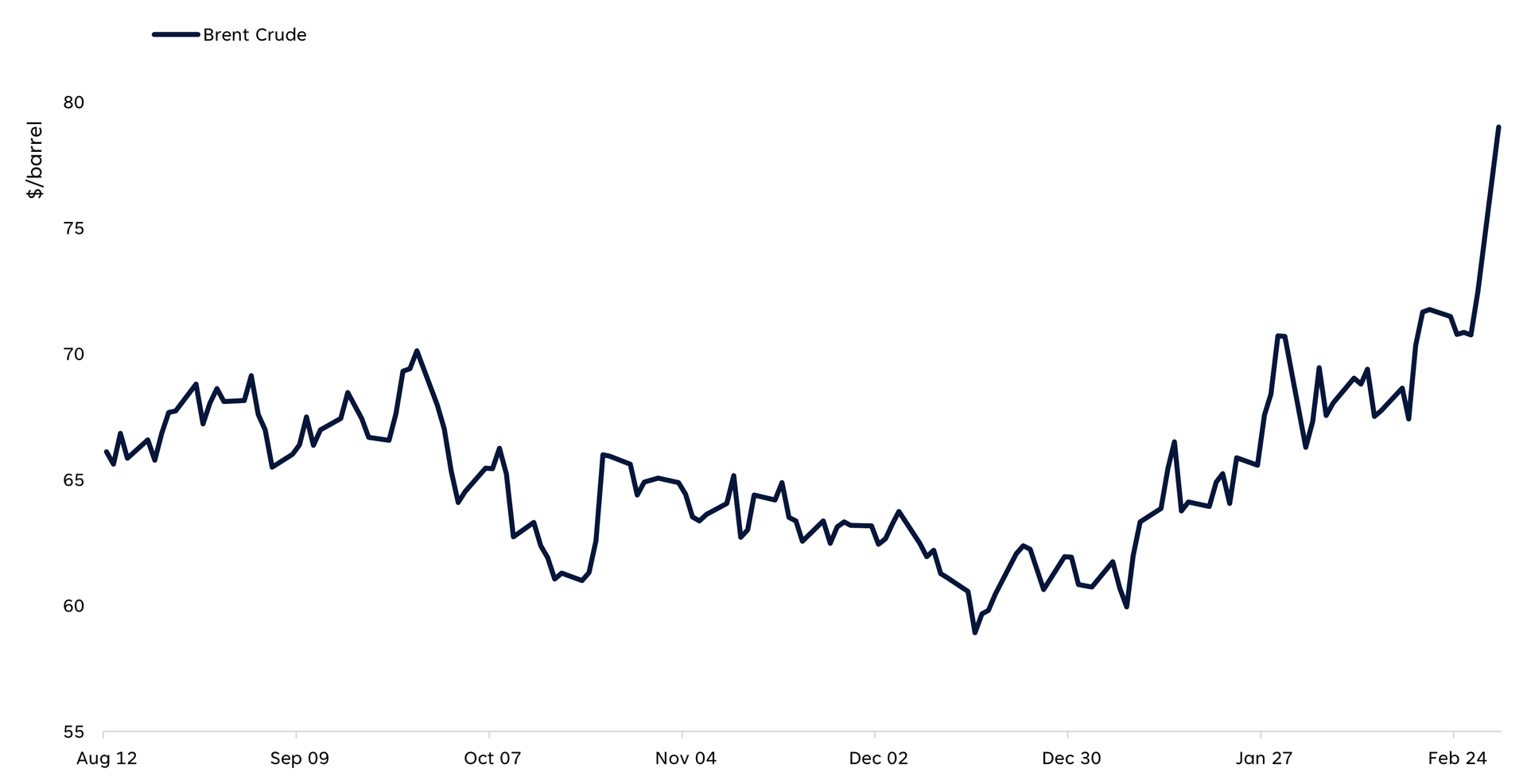
Source: LPL Research, Bloomberg 03/02/26
Disclosures: Past performance is no guarantee of future results.
Given how rapidly the situation continues to evolve, closely following movements in energy prices remains one of the most effective ways to assess the level and durability of the underlying geopolitical risk. Oil and natural gas markets tend to adjust quickly to new information, which means they can serve as a real-time barometer of whether tensions are beginning to ease, stabilize, or intensify. Monitoring these markets will therefore be essential for understanding how the conflict may continue to influence global market conditions in the days and weeks ahead.
IMPORTANT DISCLOSURES
This material is for general information only and is not intended to provide specific advice or recommendations for any individual. There is no assurance that the views or strategies discussed are suitable for all investors. To determine which investment(s) may be appropriate for you, please consult your financial professional prior to investing.
Investing involves risks including possible loss of principal. No investment strategy or risk management technique can guarantee return or eliminate risk.
Indexes are unmanaged and cannot be invested into directly. Index performance is not indicative of the performance of any investment and does not reflect fees, expenses, or sales charges. All performance referenced is historical and is no guarantee of future results.
This material was prepared by LPL Financial, LLC. All information is believed to be from reliable sources; however LPL Financial makes no representation as to its completeness or accuracy.
Unless otherwise stated LPL Financial and the third party persons and firms mentioned are not affiliates of each other and make no representation with respect to each other. Any company names noted herein are for educational purposes only and not an indication of trading intent or a solicitation of their products or services.
Asset Class Disclosures –
International investing involves special risks such as currency fluctuation and political instability and may not be suitable for all investors. These risks are often heightened for investments in emerging markets.
Bonds are subject to market and interest rate risk if sold prior to maturity.
Municipal bonds are subject and market and interest rate risk and potentially capital gains tax if sold prior to maturity. Interest income may be subject to the alternative minimum tax. Municipal bonds are federally tax-free but other state and local taxes may apply.
Preferred stock dividends are paid at the discretion of the issuing company. Preferred stocks are subject to interest rate and credit risk. They may be subject to a call features.
Alternative investments may not be suitable for all investors and involve special risks such as leveraging the investment, potential adverse market forces, regulatory changes and potentially illiquidity. The strategies employed in the management of alternative investments may accelerate the velocity of potential losses.
Mortgage backed securities are subject to credit, default, prepayment, extension, market and interest rate risk.
High yield/junk bonds (grade BB or below) are below investment grade securities, and are subject to higher interest rate, credit, and liquidity risks than those graded BBB and above. They generally should be part of a diversified portfolio for sophisticated investors.
Precious metal investing involves greater fluctuation and potential for losses.
The fast price swings of commodities will result in significant volatility in an investor's holdings.
This research material has been prepared by LPL Financial LLC.
Not Insured by FDIC/NCUA or Any Other Government Agency | Not Bank/Credit Union Deposits or Obligations | Not Bank/Credit Union Guaranteed | May Lose Value
For Public Use – Tracking: #1072327
- Mullin's take on the "4% Retirement Rule"
- Navigate "Bad Portfolio Weather"
- Tips to Optimize Social Security






Articles and Assets
What are your Priorities?
Well it’s the end of the year. I just searched on Google for “market outlook 2018.” I came up with a little over 58-million “results.”
So should you be investing in stocks in 2018? The quick answer: It’s likely a prudent part of your portfolio. But it depends on your circumstances, right?
It’s apparently popular to throw your hat in the ring.
A mantra that you hear among disciplined professionals is to “stay the course.”
Then you hear “sell high, buy low.”
Who’s right?
The relief of a disciplined strategy is that it can be tailored to you. And tailor we think you should.
Yes, it’s possible that an investor may not utilize stocks in their portfolio at all. Or you may decide to go “all in” with a diversified stock portfolio.
(Side effects from tailoring a strategy may include increased confidence & persistence, apathy toward daily market reports, and increased focus on what really matters.)
Let’s begin with the “Why” of investing for you. Then you can request 15-minutes on the phone discuss your “how.”
So “Why Should You Invest”
Life changes and our “why” of investing ought to transform with life. Some invest for sport – they like the risk/reward of investing – they’re in it for the thrill. I don’t hang with this crowd.
Most of us ought to invest for things we want. Our money & our goals are serious. By investing in a diversified portfolio we can pursue things we want.
1. Living A Comfortable Retirement: Retirement is a noun. It’s up to you to really design and live a retirement that reflects you.
2. Purchasing a Home: Home is a place to live. It can take a down payment.
3. Passing an Inheritance on to Family:
4. Student Loan Shield: This idea is important for many Millennial graduates. Student loans can dominate your budget. But instead of accelerating those payments, what if you paid your required payments, and then invested the additional money that you were going to pay against your loan balance?
5. Emergency Reserves: You probably have read that it’s prudent to keep a relative healthy amount of cash in your checking/savings. Once you’ve achieved that, then you can consider investing additional funds. Go a step further and consider a non-retirement account for you and your house. You can spend this on cars, vacations or use it just as described in #4.
The Dow Jones has seen positive results, so far, in 2017. It’s unusual and sort of uncomfortable as the independent financial advisor. Why is it uncomfortable?
What would sting & linger longer? Finding $20 in the parking lot? Or finding a $20 parking fine on your windshield?
We’ve been finding a lot of metaphorical “$20’s” (i.e. “positive results”) in our portfolios this year. So the second we find a parking fine (or a few in a row) we’ll be sure to ask if stocks are still the right place to park our money.
Complacency can work against us, Dear Clients. Just keep recalling your long-haul strategy and your “why” of investing.
***
Peter Mullin is an independent financial advisor registered through LPL Financial. He lives in Rogers, MN with his family. He was born and raised in St. Cloud, MN. Mullin Wealth Management is located in Waite Park, MN.
The opinions voiced in this material are for general information only and are not intended to provide specific advice or recommendations for any individual.
Investing involves risk including loss of principal.
There is no guarantee that a diversified portfolio will enhance overall returns or outperform a non-diversified portfolio. Diversification does not protect against market risk.
All performance referenced is historical and is no guarantee of future results.
All indices are unmanaged and may not be invested into directly. No strategy assures success or protects against loss.