



Reflecting on Feb 2020 and Coronavirus: How are you doing?

Peter Mullin • March 6, 2020
Read time: 6-8 minutes

The last week of February was as an historically stomach grabbing week for the US Markets - and investors. 

So let me first say thank you and congratulate you for adding to your experience as an investor. 

It was the quickest -10% slide for the S&P 500 in history. It was like ripping a band-aid off…or shooting down a steep rollercoaster. The week and coronavirus fears did not give us much time to step back and think.

The good news? Over the past 40-years, the S&P 500 has never finished at it’s intra-year low-point level. More good news? Corrections are natural and annual occurrences. I did not say they are comfortable!(LPL Research)

There are three major points that I share in this message to you, my Clients. Here are the three points in-case you do not have the time to read them all; feel free to jump ahead to what interests you:
  1. How was I feeling during all of this?
  2. What action can you still take? And what action was being taken?
  3. Direction and calculated optimism moving forward.

1. How was I feeling as your financial guide?

I said in a Live video event, “I am not about to switch to decaf.”

I deployed a lot of communication tools to reach out to you. I was more concerned about taming client concerns because the last week of February was so unusual. 

*I used Facebook and Email as rapid touch-points for you. I realize not all clients utilize Facebook. 
*I was calling you. I believe in being accessible and proactive.
*I held my first-ever Facebook Live stream event; over 600 people watched all 7-minutes, so far…Go over now and watch it. >> share my Facebook site and follow it. I think you will be glad you did when we jump into the next inevitable bout of uncertainty.
2. What action can you still take?

*Look the other way. I have heard clients share that they will be shredding their February statements before they even look at them. While I can’t tell you to discard your statements without reviewing them … I can tell you the wisdom in this is learning to look at your portfolio value as something that should fluctuate. February 2020 is already history. 
*This too shall pass.
*My hope is that you feel that the news outside our control has felt far worse than the bite.
*Revisit what your target result range for a portfolio like yours is, or ought to be. 
*You can add to your investments. 


Watch this: Why average results


2b. Trust the strategy and process:

*1,896: That is the approximate number of transactions that took place for clients between Monday, Feb. 24 – Mar. 3, 2020. Most of this occurred without clients having to do anything. This does not include actions that may have been taken within mutual funds. 
(This includes buys, deposits and withdrawals, distributions, income, reinvestments, sells, and systematic trades.)
*For comparison: 351 similar transactions occurred at the end of January (Jan 20 – Jan 28, 2020).
*Retirement clients still received their funds to live off of.
*Diversification was at work. Bonds, cash, cash-like investments, and broad diversification can have its day during bad portfolio weather.

3. Direction and Calculated Optimism 

Why did Coronavirus have an impact on investments? And if Coronavirus is going to develop more in the US, then how can you tell me it will get better?

Politics, facts, and current events can affect investors. That is what happened last week. But there is hardened history to lean on and reason to proceed onward with calculated optimism.  

Remember, when you buy mutual funds or stocks you are buying shares. You are not buying a fixed price per share. A shares price-tag (or market value) fluctuates by the minute and/or day, week, and month. The hope is that the money provides an income stream and/or growth for your money over time. 

At least once per year, on average, shares of what you own, can start to jump up-and-down in value. It is like the turbulence caused by air pockets when you are on a plane. 99.9% of the time it is normal … albeit uncomfortable. But it’s that pesky .01% that gets folks thinking… what if this is different? This is going to get worse…

Fear had hold of the markets last week. There are volatility gauges that pros watch - and you can, too. Clients, I have not seen the level of spikes in volatility and fear like we just saw, since 2008/09. (As measured by the VIX.) The good news? It is settling down.

News sources still seem to be providing hourly updates of the death toll of this virus. Not only is this morbid, but I feel irresponsible. Imagine if we saw a daily thermometer count for another serious illness. We would certainly wash our hands like our hard-working mothers taught us to do.
  
The news has notably adopted a #FactsNotFear mantra since last week. Last week, I must have heard, “coronavirus,” every minute from news sources. That is not an exaggeration... Now I am noticing hourly updates. 

Perhaps by next week we will hear stories about spring and baseball and positive events.

Sidebar question: Seriously. What happens to all these stocks if “nobody” is buying them? Good question. Actually, there is a human in-charge of holding shares of stocks that are not selling. They are called a Designated Market Maker (DMM). They also help to facilitate a controlled market for shares. (Investopedia.) Can I get you thinking about this more? Think about this: What typically happens to a house the longer it goes unsold? The same can happen to a stock when more are selling than buying. The DMM, for example, is busy making a market for it by facilitating a price reduction. 

The level of fear and volume of stories last week led me to do some soft hyper-local research over the weekend.

My experience told me to checkout the local Target shelves. See the pictures below. (A boast: I was observing the shelves over the weekend before the news made ‘empty market shelves’ a story.)

Pictured: A Tweet from Yours Truly. Ryan Detrick is LPL’s Senior Market Strategist. You can see him on CNBC, WSJ, Bloomberg, etc. Lots of thanks to his entire team for leaning in last week!

I agree that the numbers of those affected by COVID-19 will increase. I also think survivor t-shirts will be a thing … actually, I just searched for them. And you can already BUY the t-shirts. A bit premature, don’t you think?

Folks, this predictably irrational behavior is what has me responding in a methodical and passionate manner on yours and my behalf. 

These mantras and a historical line of reasoning have me leaning into this bad news:

"I will tell you how to become rich. Close the doors. Be fearful when others are greedy. Be greedy when others are fearful." - Warren Buffett

"The four most dangerous words in investing are: 'this time it's different.'" - Sir John Templeton

"In investing, what is comfortable is rarely profitable." - Robert Arnott

I sent out an e-mail last week harkening Sir John’s mantra. Read it here >>


If you desire to read more…

A Reminder of my Implicit Operating Assumption:
I believe many of my clients benefit from an advisory relationship. With this relationship one implicit assumption is this: We both care about your portfolio's net results.

Call me crazy, but I think it matters what your portfolio keeps. I pay attention to your portfolio, investments, and tax implications during bad portfolio weather.

Your investment objectives, income needs, timeframe, and overall investment costs can bear a lot of weight on your net portfolio results overtime. This is why having a healthy average portfolio target result range is important.


***

The opinions voiced in this material are for general information only and are not intended to provide specific advice or recommendations for any individual.

Investing involves risk including loss of principal.

There is no guarantee that a diversified portfolio will enhance overall returns or outperform a non-diversified portfolio. Diversification does not protect against market risk.

All performance referenced is historical and is no guarantee of future results. 

The Standard & Poor's 500 Index is a capitalization weighted index of 500 stocks designed to measure performance of the broad domestic economy through changes in the aggregate market value of 500 stocks representing all major industries.

All indices are unmanaged and may not be invested into directly.

No strategy assures success or protects against loss.
Find Time with Peter


  • Mullin's take on the "4% Retirement Rule"
  • Navigate "Bad Portfolio Weather"
  • Tips to Optimize Social Security 
 

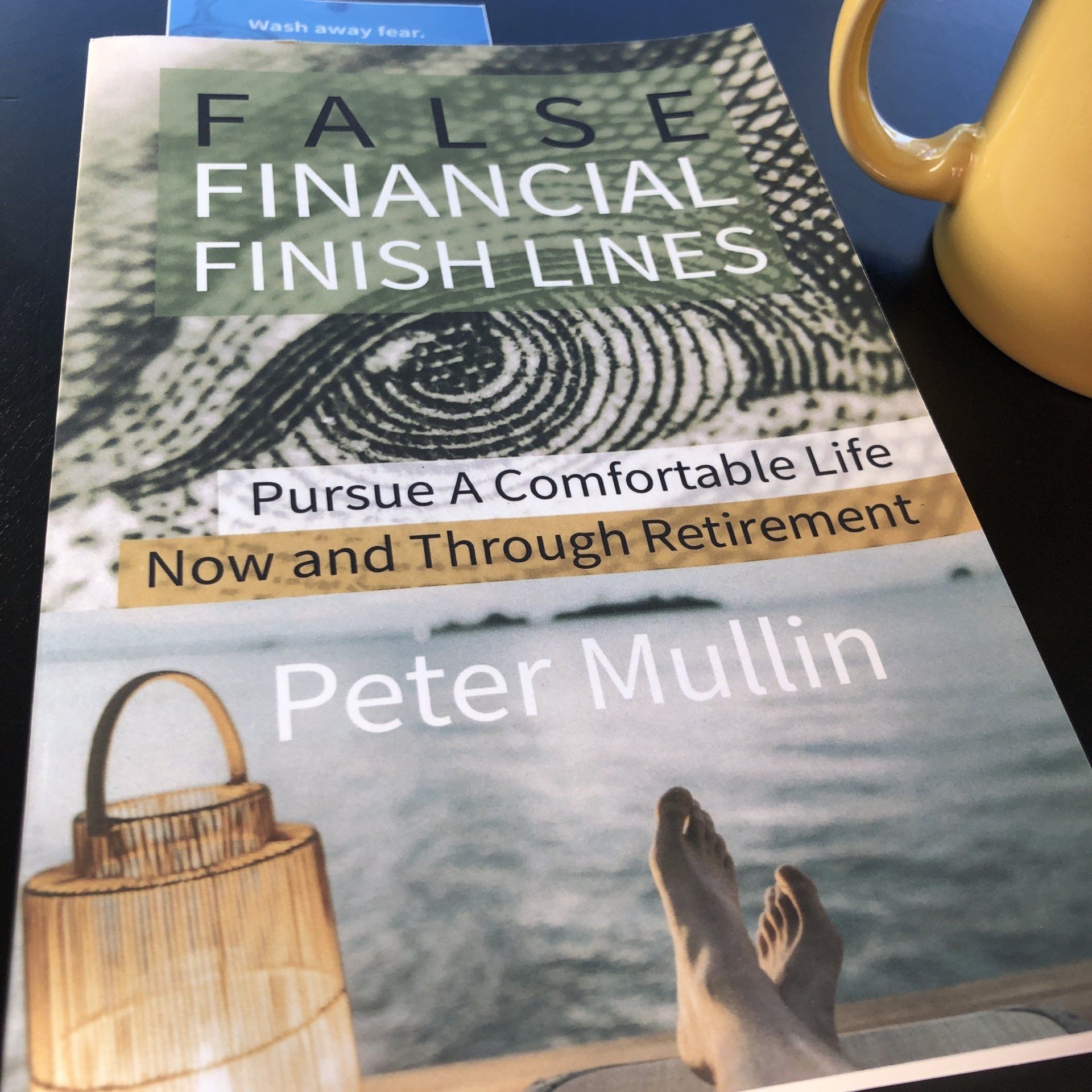
Start Reading your 44-page EBook Sample >>
By Peter Mullin March 4, 2026
My best advice a manic market By Peter Mullin, CEO/Financial Consultant Clients, we have never been in it for last year's results. Instead, we are betting on future prospects. We know life is not perfect. But over time, it will be okay. There are life lessons we can draw on from investing. One lesson involves taking bad periods with a grain of salt. Uncertainty is the price we pay for an investment’s potential rewards. Iran is striking back at the Middle East and allies like a multi-headed medusa. This did just occur in June of 2025. The difference is there is a presumed push for a regime change. It is a nail biting time, once again. My best advice is to keep the long view in mind during times that test our wits. But there is war. There is hyperinflation. This market is out of control. I can't lose anymore…I won’t live long enough to recover. How long has it taken a market to bounce back? Surprisingly, markets bounce back quite quickly from the real terror of missiles, mortars and military strikes. JP Morgan’s chart shows that it takes 2-3 weeks (or less) on average. The average drawdown is about -5.3%.
March 3, 2026
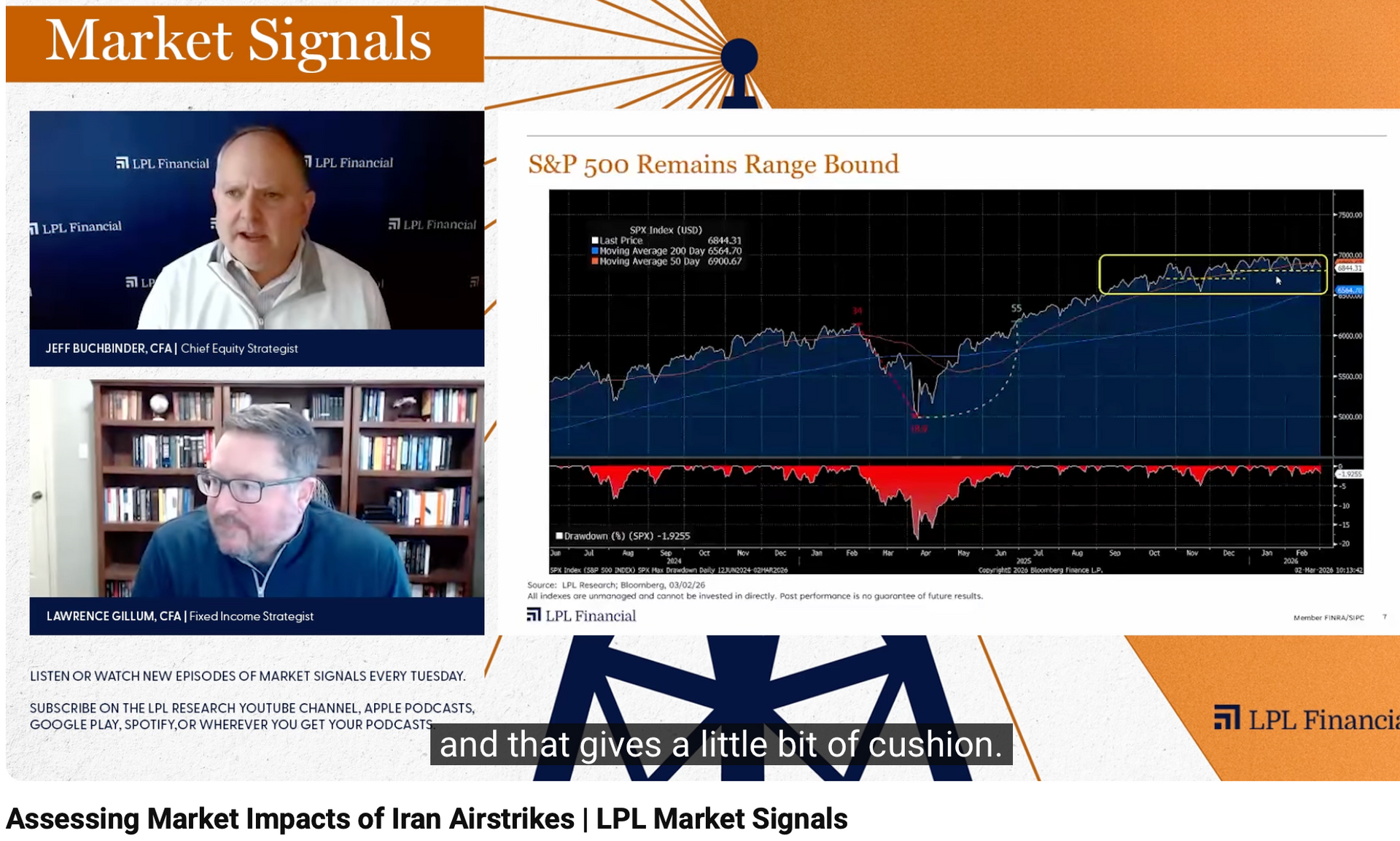
This week on LPL Market Signals, Chief Equity Strategist Jeff Buchbinder and Chief Fixed Income Strategist Lawrence Gillum, discuss potential stock and bond market impacts of the airstrikes on Iran over the weekend. Tracking: #1072379
March 3, 2026
Kristian Kerr | Head of Macro Strategy Last Updated: March 02, 2026 Over the weekend, the United States and Israel conducted a coordinated series of missile and drone strikes against Iran, targeting several high-value military installations in an effort to hinder Iran’s nuclear development efforts. These operations resulted in the death of Iran’s Supreme Leader, Ayatollah Ali Khamenei, marking a significant escalation and immediately heightening regional tensions. Iran quickly retaliated by launching a broad series of missile attacks directed not only at Israel but also at multiple Gulf states, including Qatar, the United Arab Emirates, and Bahrain. The repercussions were felt across the region. Several Gulf countries responded by shutting down their airspace and closing their equity markets. The conflict also affected global energy flows. Tanker traffic through the Strait of Hormuz, a vital waterway that carries about 20% of the world’s oil supply, came to a near standstill as shipping companies diverted vessels away from the area for safety reasons. Plus, Qatar shuttered liquefied natural gas production at the world’s largest export facility after being targeted by an Iranian drone strike. President Donald Trump stated that U.S. strikes on Iran would continue, signaling that tensions are likely to remain elevated for the next few weeks. From a market perspective, the energy market is the primary way through which this crisis is likely to impact global markets. Any sustained disruption to oil or natural gas flows, especially if both severe and long lasting, have the potential to influence inflation expectations, weigh on business confidence, and elevate volatility across asset classes. In simple terms, the more intense and prolonged the geopolitical shock, the larger the likely market impact. This pattern was already evident when markets opened on Monday. Brent crude, the global benchmark for oil prices, briefly touched $82 per barrel as traders responded to the possibility of tighter supply conditions. A sustained period of elevated prices would place upward pressure on inflation expectations, and that in turn could have broader consequences for both equity and interest rate markets. However, for such a persistent rise in crude prices to materialize, markets would likely need evidence of a more prolonged or even total shutdown of the Strait of Hormuz. A disruption of that scale would represent a meaningful escalation relative to what has occurred so far and would justify a more substantial risk premium in energy markets. There is also a political dimension tied to Iran’s internal stability, particularly regarding how the Islamic Revolutionary Guard Corps (IRGC) chooses to respond. Whether it opts to pull back or escalate further will play a major role in determining how much of the current shock reflects elevated risk premiums versus a true disruption to physical supply.  Oil Prices Spike as Strait of Hormuz Tanker Traffic Stalls
February 18, 2026
LPL Market Signals
By Peter Mullin January 20, 2026
My values and mission
By Peter Mullin November 11, 2025
“Optimism sounds like a sales pitch. Pessimism sounds like someone trying to help you .” Morgan Housel, The Psychology of Money I do believe parts of the stock market are due for a reality check. But our big-picture, combined with our investment process says to hang in there. Connect with us now, especially if anything has changed for you. Remember April and Tariff Tantrums? Portfolio risk still matters Does is feel like stocks have done better than they actually have this year? Last year was a bumper year. And this year many have likely already forgotten the sharp April tariff tantrums. In recent history, market reality checks have been brief. For example, COVID caused stock markets to drop aggressively, followed by a wild recovery. Then 2022 reminded investors that taking imprudent risk can burn you. This rapid cycle of loss and recoveries makes it easier to get complacent. Yet, historical patterns suggest this isn't the time to ignore risk. It's easy to take on more risk after enjoying strong returns. But this can be dangerous—history doesn’t repeat, but it often rhymes. Let’s talk portfolio risk; risk can = rewards; but at what price? Let’s take a humble breath. Recall the math and logic of portfolio losses. Bigger portfolio risks require a higher pain tolerance. Large portfolio losses are hard to recover from. If a $100,000 portfolio loses 20%, it drops to $80,000. To get back to even requires a 25% return on your $80,000.  It’s easy to take on more and more risk when we are being rewarded. But many experienced retirees know, “easy come, easy go.”
By Peter Mullin October 8, 2025
We're pleased to offer 2025 Midyear Outlook: Pragmatic Optimism, Measured Expectations, providing a comprehensive recap of the economy and market to date, plus a forecast through year-end.
More Posts

Articles and Assets

Your Prosperity Puzzle: Solved
What direction are you taking with your debts, income and assets?

What are your Priorities?

Schedule an Appointment

Well it’s the end of the year. I just searched on Google for “market outlook 2018.” I came up with a little over 58-million “results.”

So should you be investing in stocks in 2018? The quick answer: It’s likely a prudent part of your portfolio. But it depends on your circumstances, right?

It’s apparently popular to throw your hat in the ring.

A mantra that you hear among disciplined professionals is to “stay the course.”

Then you hear “sell high, buy low.”

Who’s right?

The relief of a disciplined strategy is that it can be tailored to you. And tailor we think you should.

Yes, it’s possible that an investor may not utilize stocks in their portfolio at all. Or you may decide to go “all in” with a diversified stock portfolio.

(Side effects from tailoring a strategy may include increased confidence & persistence, apathy toward daily market reports, and increased focus on what really matters.)

Let’s begin with the “Why” of investing for you. Then you can request 15-minutes on the phone discuss your “how.”

So “Why Should You Invest”

Life changes and our “why” of investing ought to transform with life. Some invest for sport  – they like the risk/reward of investing – they’re in it for the thrill. I don’t hang with this crowd.

Most of us ought to invest for things we want. Our money & our goals are serious. By investing in a diversified portfolio we can pursue things we want.

1. Living A Comfortable Retirement: Retirement is a noun. It’s up to you to really design and live a retirement that reflects you.

2. Purchasing a Home: Home is a place to live. It can take a down payment.

3. Passing an Inheritance on to Family:

4. Student Loan Shield: This idea is important for many Millennial graduates. Student loans can dominate your budget. But instead of accelerating those payments, what if you paid your required payments, and then invested the additional money that you were going to pay against your loan balance?

5. Emergency Reserves: You probably have read that it’s prudent to keep a relative healthy amount of cash in your checking/savings. Once you’ve achieved that, then you can consider investing additional funds. Go a step further and consider a non-retirement account for you and your house. You can spend this on cars, vacations or use it just as described in #4.

The Dow Jones has seen positive results, so far, in 2017. It’s unusual and sort of uncomfortable as the independent financial advisor. Why is it uncomfortable?

What would sting & linger longer? Finding $20 in the parking lot? Or finding a $20 parking fine on your windshield?

We’ve been finding a lot of metaphorical “$20’s” (i.e. “positive results”) in our portfolios this year. So the second we find a parking fine (or a few in a row) we’ll be sure to ask if stocks are still the right place to park our money.

Complacency can work against us, Dear Clients. Just keep recalling your long-haul strategy and your “why” of investing.

***

Peter Mullin is an independent financial advisor registered through LPL Financial. He lives in Rogers, MN with his family. He was born and raised in St. Cloud, MN. Mullin Wealth Management is located in Waite Park, MN.

The opinions voiced in this material are for general information only and are not intended to provide specific advice or recommendations for any individual.

Investing involves risk including loss of principal.

There is no guarantee that a diversified portfolio will enhance overall returns or outperform a non-diversified portfolio. Diversification does not protect against market risk.

All performance referenced is historical and is no guarantee of future results.

All indices are unmanaged and may not be invested into directly. No strategy assures success or protects against loss.


Schedule an Appointment