




Share Power: One big reason investors should embrace bear markets and pullbacks
Investors can become fixated with the value of their portfolio. You may be like many other investors and pay attention to one highlighted fact on your IRA and 401k statements: Your total dollar value. Am I right?
- If your value is down: It feels like you are losing.
- If your value is up: It feels like you are winning.
In this article, I ask you this question, “What does your retirement portfolio’s value matter? And why should you embrace bear markets and pullbacks?”
While even a disciplined portfolio can shrink in the short term, please remember that these are false matters of importance. Does it matter that your value grows over the long-term? You bet! But do not fear your routine value fluctuations.
Some significant factors can be monitored for my clients behind the scenes. Some of these factors are automatic, whether you are retired or not. The first is share power. The second being sustained allocation.
SHARE POWER
You have a big factor working for you. Let’s call it “Share Power.” Think about this: When you invest what are you buying? (e.g., Mutual funds and stocks.)
When you invest, you are buying shares. If you bought ten shares (of ABC mutual fund) for $100 each in October, and the value of
those shares is priced at $80 in December, then you still own ten shares. In fact, you may have more shares if you reinvest dividends and capital gains. December can be a magical month where you automatically get to buy more shares through the simplicity of reinvesting. (*Disclaimer)
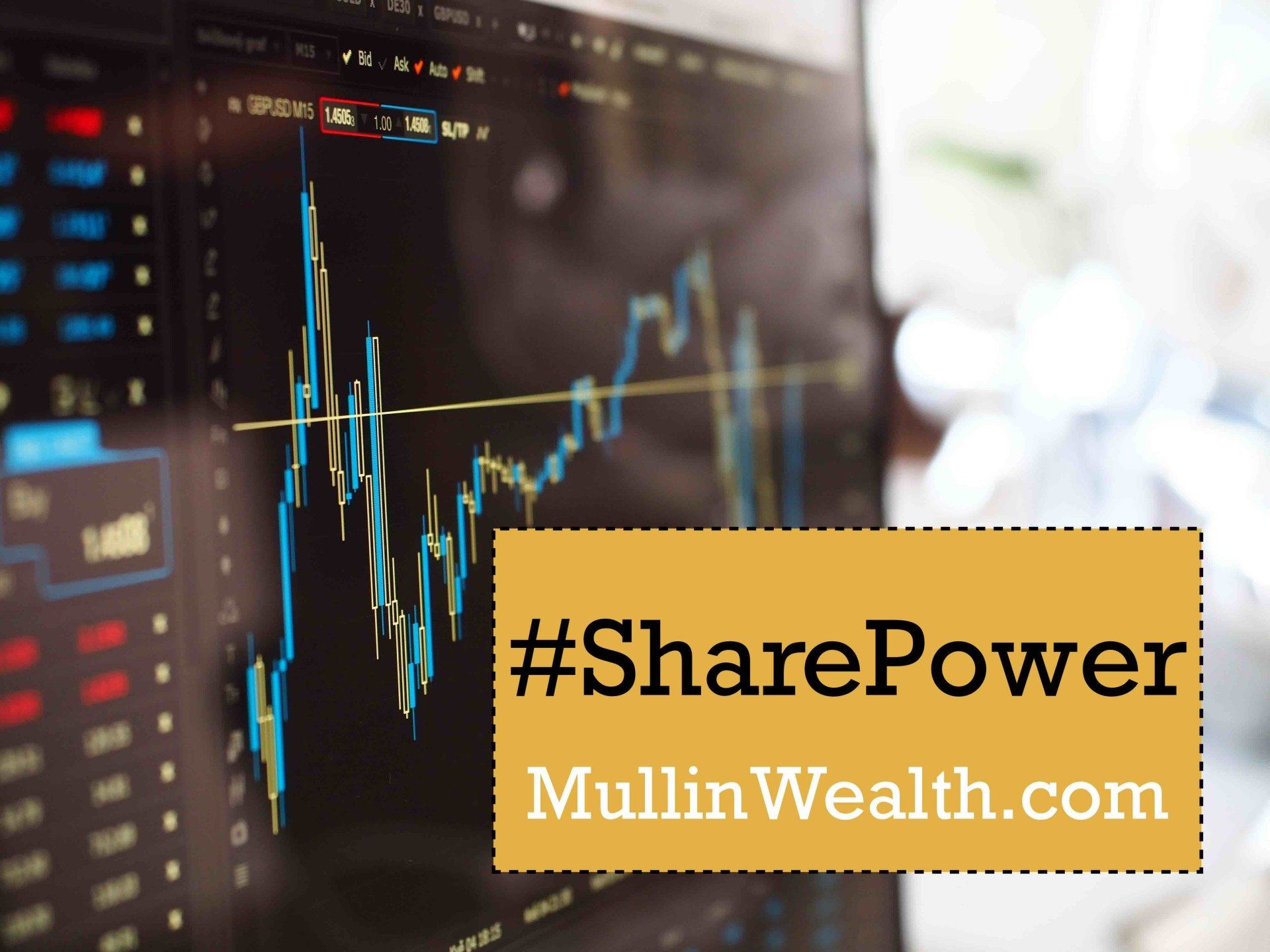
"Your portfolio value may lose value during tumultuous months in the stock market. But unless you are folding, and abandoning your strategy, you may benefit in the long haul."
Shares represent your level of ownership in mutual funds and stocks.
- Dividends can reinvest to buy more shares. When values go back up you will see the mathematical benefit.
- Suppose you bought ten shares of ABC mutual fund for $100 each in October. The value goes down to $80.
- But you end up buying one more share at $80 because you receive a dividend from this mutual fund, which you reinvest.
- A year from now those shares are valued at $100 a share. That is the original price that you bought your initial ten shares.
- But because you received your dividend and reinvested it, your value would now be $1100.
- Congratulations. You saw an increase of $100. (*Disclaimer)
SUSTAINED ALLOCATION
Allocation is another word for a category. When investing you may be guided to invest in different groups of investments. And it can be fundamental to sustain this allocation over periods.
I wrote about this here >> Asset Allocation Explained
I highlight cash (or cash-like investments) with clients in conversations. Cash is like fuel for portfolios. It can help you recoup short-term losses faster by pouring cash (or cash-like investments) into your equity when you experience a sudden pullback or bear market.
Sustained is a word that refers to supporting. So you can support your initial allocation by checking in. When you see parts of your portfolio that feel like damaged goods, you can take some of your more conservative portfolio and buy more of your portfolio that is low.
CONCLUSION: Use Share Power and Sustain Your Future Portfolio
So if you find your retirement portfolio value lower, then realize that you can buy more shares at a lower price.
Remember you may have lost dollar value in the short-term, but you can gain share power in the long-term.
I wrote about this in my book, False Financial Finish Lines. (Available on Amazon. Yes, a plug! A great way to visit many topics which I visit with clients about.)
Concerns about a Bear Market or Curious About Your Portfolio Fluctuations?
*
Disclaimer
: [
THESE ARE HYPOTHETICAL EXAMPLES AND ARE NOT REPRESENTATIVE OF ANY SPECIFIC SITUATION. YOUR RESULTS WILL VARY. THE HYPOTHETICAL RATES OF RETURN USED DO NOT REFLECT THE DEDUCTION OF FEES AND CHARGES INHERENT TO INVESTING.
]
Peter Mullin is an independent financial advisor registered through LPL Financial. He lives in Rogers, MN with his family. He was born and raised in St. Cloud, MN. Mullin Wealth Management is located headquartered in Saint Cloud, MN.
The opinions voiced in this material are for general information only and are not intended to provide specific advice or recommendations for any individual.
Investing involves risk including loss of principal.
There is no guarantee that a diversified portfolio will enhance overall returns or outperform a non-diversified portfolio. Diversification and asset allocation do not protect against market risk.
All performance referenced is historical and is no guarantee of future results.
The payment of dividends is not guaranteed. Companies may reduce or eliminate the payment of dividends at any given time.
No strategy assures success or protects against loss.
- Mullin's take on the "4% Retirement Rule"
- Navigate "Bad Portfolio Weather"
- Tips to Optimize Social Security







Articles and Assets
What are your Priorities?
Well it’s the end of the year. I just searched on Google for “market outlook 2018.” I came up with a little over 58-million “results.”
So should you be investing in stocks in 2018? The quick answer: It’s likely a prudent part of your portfolio. But it depends on your circumstances, right?
It’s apparently popular to throw your hat in the ring.
A mantra that you hear among disciplined professionals is to “stay the course.”
Then you hear “sell high, buy low.”
Who’s right?
The relief of a disciplined strategy is that it can be tailored to you. And tailor we think you should.
Yes, it’s possible that an investor may not utilize stocks in their portfolio at all. Or you may decide to go “all in” with a diversified stock portfolio.
(Side effects from tailoring a strategy may include increased confidence & persistence, apathy toward daily market reports, and increased focus on what really matters.)
Let’s begin with the “Why” of investing for you. Then you can request 15-minutes on the phone discuss your “how.”
So “Why Should You Invest”
Life changes and our “why” of investing ought to transform with life. Some invest for sport – they like the risk/reward of investing – they’re in it for the thrill. I don’t hang with this crowd.
Most of us ought to invest for things we want. Our money & our goals are serious. By investing in a diversified portfolio we can pursue things we want.
1. Living A Comfortable Retirement: Retirement is a noun. It’s up to you to really design and live a retirement that reflects you.
2. Purchasing a Home: Home is a place to live. It can take a down payment.
3. Passing an Inheritance on to Family:
4. Student Loan Shield: This idea is important for many Millennial graduates. Student loans can dominate your budget. But instead of accelerating those payments, what if you paid your required payments, and then invested the additional money that you were going to pay against your loan balance?
5. Emergency Reserves: You probably have read that it’s prudent to keep a relative healthy amount of cash in your checking/savings. Once you’ve achieved that, then you can consider investing additional funds. Go a step further and consider a non-retirement account for you and your house. You can spend this on cars, vacations or use it just as described in #4.
The Dow Jones has seen positive results, so far, in 2017. It’s unusual and sort of uncomfortable as the independent financial advisor. Why is it uncomfortable?
What would sting & linger longer? Finding $20 in the parking lot? Or finding a $20 parking fine on your windshield?
We’ve been finding a lot of metaphorical “$20’s” (i.e. “positive results”) in our portfolios this year. So the second we find a parking fine (or a few in a row) we’ll be sure to ask if stocks are still the right place to park our money.
Complacency can work against us, Dear Clients. Just keep recalling your long-haul strategy and your “why” of investing.
***
Peter Mullin is an independent financial advisor registered through LPL Financial. He lives in Rogers, MN with his family. He was born and raised in St. Cloud, MN. Mullin Wealth Management is located in Waite Park, MN.
The opinions voiced in this material are for general information only and are not intended to provide specific advice or recommendations for any individual.
Investing involves risk including loss of principal.
There is no guarantee that a diversified portfolio will enhance overall returns or outperform a non-diversified portfolio. Diversification does not protect against market risk.
All performance referenced is historical and is no guarantee of future results.
All indices are unmanaged and may not be invested into directly. No strategy assures success or protects against loss.