



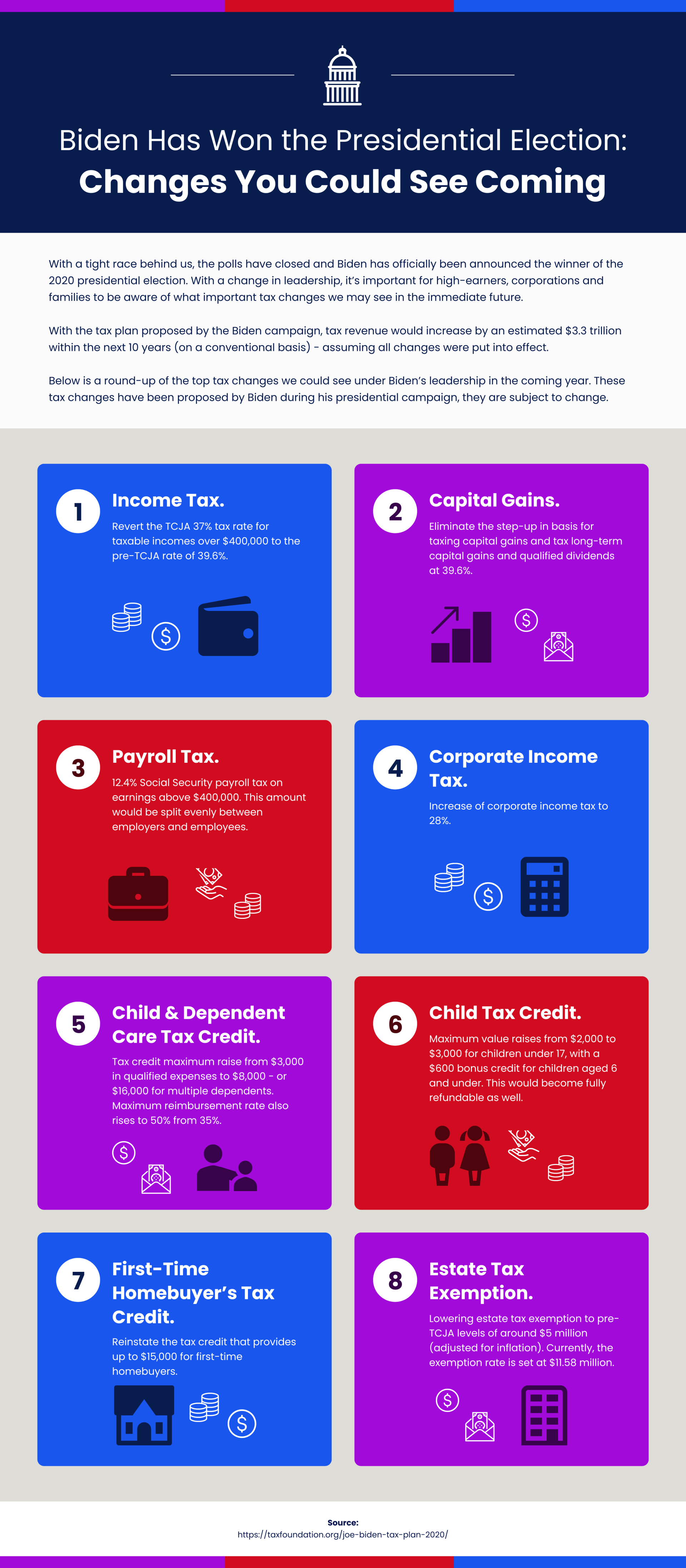
Biden is the President Elect: Tax changes are coming

A couple years back I hosted a few in-person presentations at the local library touting the Trump tax code changes. Now I will be touting Biden tax code changes. It can pay to be politically agnostic as the pendulum swings back-and-forth with history and its presidential administrations.
While D.C. does not hold all the tax cards – state and local taxes, education levies, for example – an administration can change how clients and Yours Truly navigates the current tax environment.
Based on paint sales at Home Depot and Lowes, 2020 has demonstrated that watching paint dry CAN be more thrilling than preparing taxes!
Still, here are our friendly end-of-year tax reminders:
•We encourage collaboration with your tax accountant. Did you know that clients can drop off their info with their tax professional and say, "Talk to Team Mullin to make sure you got everything from them?" Call or e-mail us. We are happy to help!
•No RMD requirement for 2020. What is an RMD? A required minimum distribution is D-Day for old IRA and 401(k) money. The government requires that you take out a minimum amount starting at a certain age from certain retirement accounts.
•The SECURE Act changed the RMD starting age to 72. It used to be the calendar year you turned 70.5. Finally. Who celebrates their 70.5 birthday anyway?
•You may note tax harvesting if it applies to your advisory non-qualified (taxable) investment account(s). You may also anticipate increased capital gains. 2020 saw volatility and with this volatility can come increased investment activity.
•You may not be getting full credit for those tax-deductible charity gifts. But we can help to try and change that. Read about a charitable IRA gift strategy we are helping clients with.
•Even though RMD requirements were waived due to the pandemic, a charitable IRA gift can still work.
•IRA contributions can be made through your tax filing date.
•Tax form deadlines? Generally, a "safe" date to meet with your tax professional is AFTER March 15, 2021. It is possible your tax forms will be amended. It is possible that ONE or more investments you own cause a delay in a tax form.
The information provided is not intended to be a substitute for specific individualized tax planning or legal advice. We suggest that you consult with a qualified tax or legal advisor.
All investing involves risk, including the possible loss of principal, and there can be no assurance that any investment strategy will be successful. Generally, the more potential for growth offered by an investment, the more risk it carries.
The opinions voiced in this material are for general information only and are not intended to provide specific advice or recommendations for any individual.
Visit www.MullinWealth.com to learn more and to review states we are registered in.
The opinions voiced in this material are for general information only and are not intended to provide specific advice or recommendations for any individual.
Investing involves risk including loss of principal. No strategy assures success or protects against loss.
Securities and Advisory services offered through LPL Financial, A Registered Investment Advisor, Member FINRA/SIPC.
The LPL Financial registered representative associated with this site may only discuss and/or transact securities business with residents of the following states: AK, AR, AZ, CA, CO, FL, IA, ID, IL, MN, MO, NM, TX, WA, WI
The information being provided is strictly as a courtesy. When you link to any of the web sites provided here, you are leaving this web site. We make no representation as to the completeness or accuracy of information provided at these web sites.
- Mullin's take on the "4% Retirement Rule"
- Navigate "Bad Portfolio Weather"
- Tips to Optimize Social Security







Articles and Assets
What are your Priorities?
Well it’s the end of the year. I just searched on Google for “market outlook 2018.” I came up with a little over 58-million “results.”
So should you be investing in stocks in 2018? The quick answer: It’s likely a prudent part of your portfolio. But it depends on your circumstances, right?
It’s apparently popular to throw your hat in the ring.
A mantra that you hear among disciplined professionals is to “stay the course.”
Then you hear “sell high, buy low.”
Who’s right?
The relief of a disciplined strategy is that it can be tailored to you. And tailor we think you should.
Yes, it’s possible that an investor may not utilize stocks in their portfolio at all. Or you may decide to go “all in” with a diversified stock portfolio.
(Side effects from tailoring a strategy may include increased confidence & persistence, apathy toward daily market reports, and increased focus on what really matters.)
Let’s begin with the “Why” of investing for you. Then you can request 15-minutes on the phone discuss your “how.”
So “Why Should You Invest”
Life changes and our “why” of investing ought to transform with life. Some invest for sport – they like the risk/reward of investing – they’re in it for the thrill. I don’t hang with this crowd.
Most of us ought to invest for things we want. Our money & our goals are serious. By investing in a diversified portfolio we can pursue things we want.
1. Living A Comfortable Retirement: Retirement is a noun. It’s up to you to really design and live a retirement that reflects you.
2. Purchasing a Home: Home is a place to live. It can take a down payment.
3. Passing an Inheritance on to Family:
4. Student Loan Shield: This idea is important for many Millennial graduates. Student loans can dominate your budget. But instead of accelerating those payments, what if you paid your required payments, and then invested the additional money that you were going to pay against your loan balance?
5. Emergency Reserves: You probably have read that it’s prudent to keep a relative healthy amount of cash in your checking/savings. Once you’ve achieved that, then you can consider investing additional funds. Go a step further and consider a non-retirement account for you and your house. You can spend this on cars, vacations or use it just as described in #4.
The Dow Jones has seen positive results, so far, in 2017. It’s unusual and sort of uncomfortable as the independent financial advisor. Why is it uncomfortable?
What would sting & linger longer? Finding $20 in the parking lot? Or finding a $20 parking fine on your windshield?
We’ve been finding a lot of metaphorical “$20’s” (i.e. “positive results”) in our portfolios this year. So the second we find a parking fine (or a few in a row) we’ll be sure to ask if stocks are still the right place to park our money.
Complacency can work against us, Dear Clients. Just keep recalling your long-haul strategy and your “why” of investing.
***
Peter Mullin is an independent financial advisor registered through LPL Financial. He lives in Rogers, MN with his family. He was born and raised in St. Cloud, MN. Mullin Wealth Management is located in Waite Park, MN.
The opinions voiced in this material are for general information only and are not intended to provide specific advice or recommendations for any individual.
Investing involves risk including loss of principal.
There is no guarantee that a diversified portfolio will enhance overall returns or outperform a non-diversified portfolio. Diversification does not protect against market risk.
All performance referenced is historical and is no guarantee of future results.
All indices are unmanaged and may not be invested into directly. No strategy assures success or protects against loss.